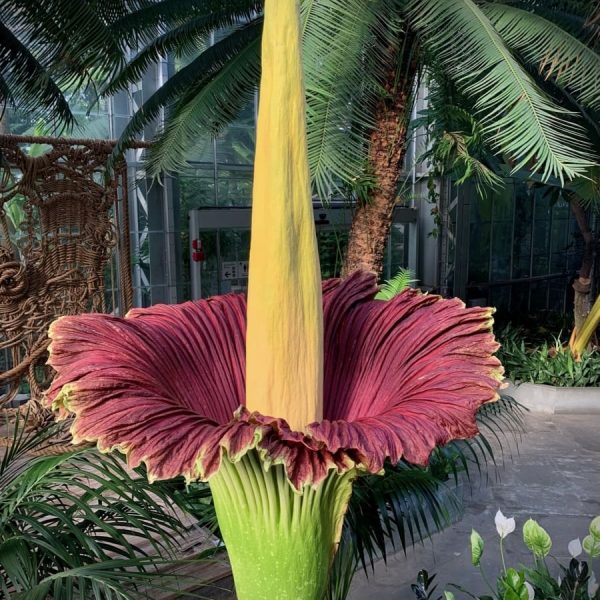
Lady Macdeath's True Corpse On Display
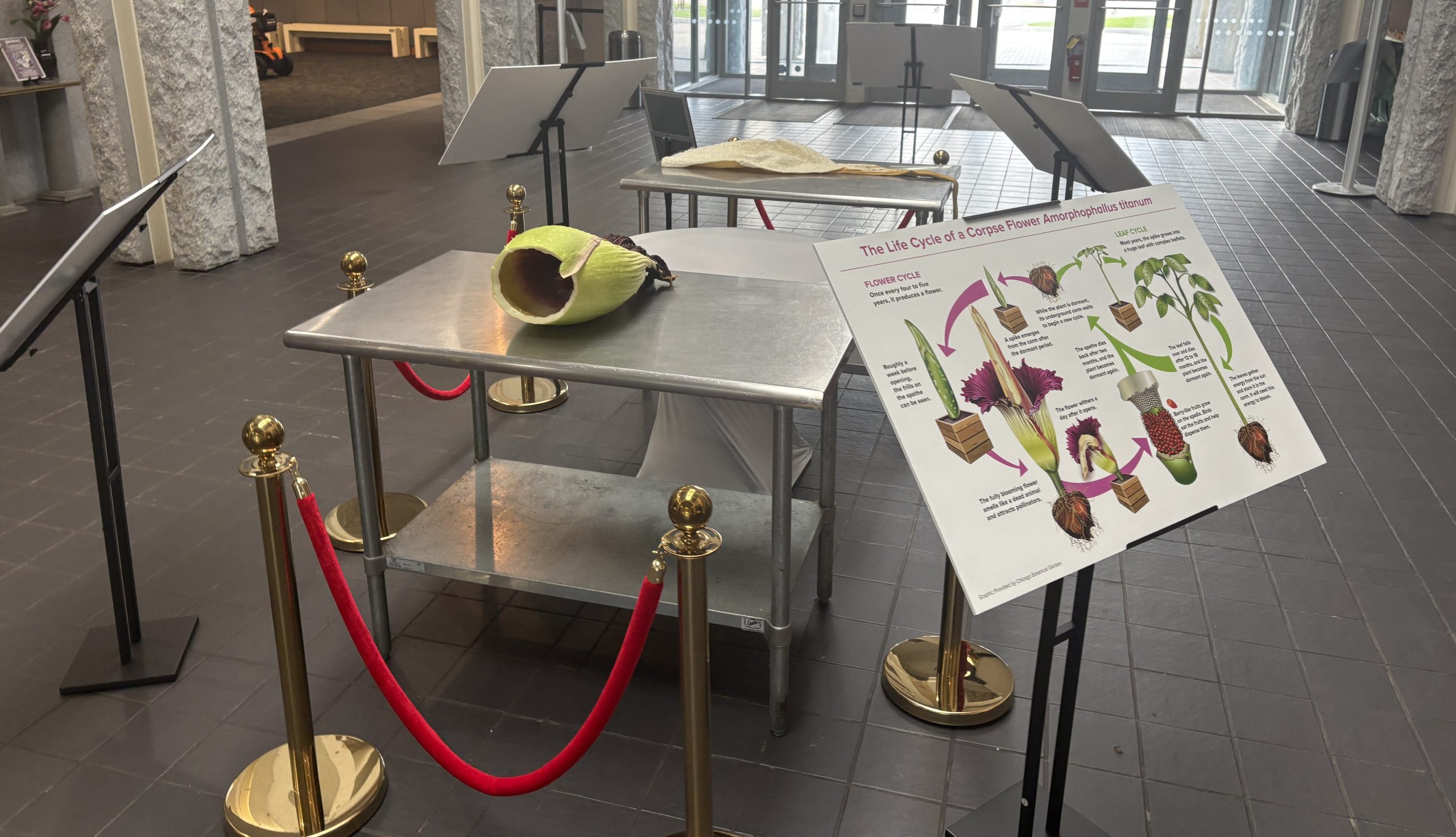
Norfolk Botanical Garden’s rare corpse flower (Amorphophallus titanum) bloomed late in the evening on July 4th and will end her reign at 10pm this evening on Monday, July 6, 2020. However, there is another opportunity to see her in true corpse fashion on Tuesday, July 7, 2026 from 9am to 7pm. Our Horticulture experts will dissect her and she will be on display in our Baker Hall Visitor Center.
We are so thankful for the incredible interest in Lady Macdeath! Thousands have already been able to witness one of the world’s most unusual, smelliest and infrequent botanical events. It might not bloom again for another 10 years!

The spectacular bloom comes as the Garden prepares to open The Garden of Tomorrow this September, an expanded project focused on plant conservation and education. The project will support efforts to protect some of the world’s most threatened plant species and contribute to global conservation efforts.
CORPSE FLOWER FUN FACTS
- There are less than 1,000 left in the wild, probably far less. Primary reason is deforestation for the production of palm oil which is needed to make shelf stable snacks. Check food labels and avoid purchase of things with palm oil to help. Sadly, that’s very difficult to do. It’s also in cosmetics and soaps. Palmolive dish soap is a good example of it literally being in the name.
- It’s not the largest flower in the world (that would be Rafflesia, also a flower that smells like rotting meat) but it is the largest unbranched inflorescence in the world. The Amorphophallus is made up of many small flowers.
- There’s no way to predict when ours, or any, will bloom again, but they take several years for the tuber to get large enough to bloom and can weigh over 100 pounds
- It’s tropical so cannot be grown in Hampton roads without a greenhouse
- They smell like rotting flesh to attract its main pollinators, carrion beetles and flies
- The scent will be most intense late the first night of bloom for those who want to experience that
- It is quite bad, some people find it too intense to be around more than a few seconds
BLOOM UPDATES
It has been a world wind experience since we began officially measuring on June 16, it grew more than two feet in just 10 days. We’ve been recording its progress every day until she officially started blooming on July 4. We expected the bloom to occur sometime between July 4 and July 8, but nature sets the schedule and she had her peak bloom overnight on July 5. Like waiting for a baby to arrive, there are signs—the dramatic growth slowed down, letting us know the bloom was around the corner. Then it was an hour by hour watch for more signs. She may not bloom again for another 10 years.
Growth/Bloom Updates:
- July 7: Open normal hours 9-7pm – Macdeath on display after dissection
- July 6: Open from 7am-10pm (ticket holders) – her reign is ending. in her final stages
- July 5: Open from 7am-10pm – bloom & smell experience
- July 4: 84 inches – overnight peak bloom
- July 3: 82.25 inches
- July 2: 80 inches
- July 1: 76.75 inches
- June 30: 73 inches
- June 29: 69 inches
- June 28: 63.25 inches
- June 27: 57.75 inches
- June 26: 50.5 inches
- June 25: 45.25 inches
- June 24: 41 inches
- June 23: 37.75 inches
- June 22: 33.75 inches
- June 19: 26 inches
- June 18: 24 inches
- June 17: 22.5 inches
- June 16: 21 inches
NBG In the News
- The Virginian Pilot: Norfolk Botanical Garden’s corpse flower could bloom by July 4
- WAVY TV 10: Time-lapse: Rare corpse flower about to bloom at Norfolk Botanical Garden
- 13 News Now WVEC: Norfolk Botanical Garden’s corpse flower enters bloom watch
- WTKR News 3: Norfolk Botanical Garden’s rare corpse flower ready to bloom soon
Welcoming our Corpse Flower
(Amorphophallus titanum)
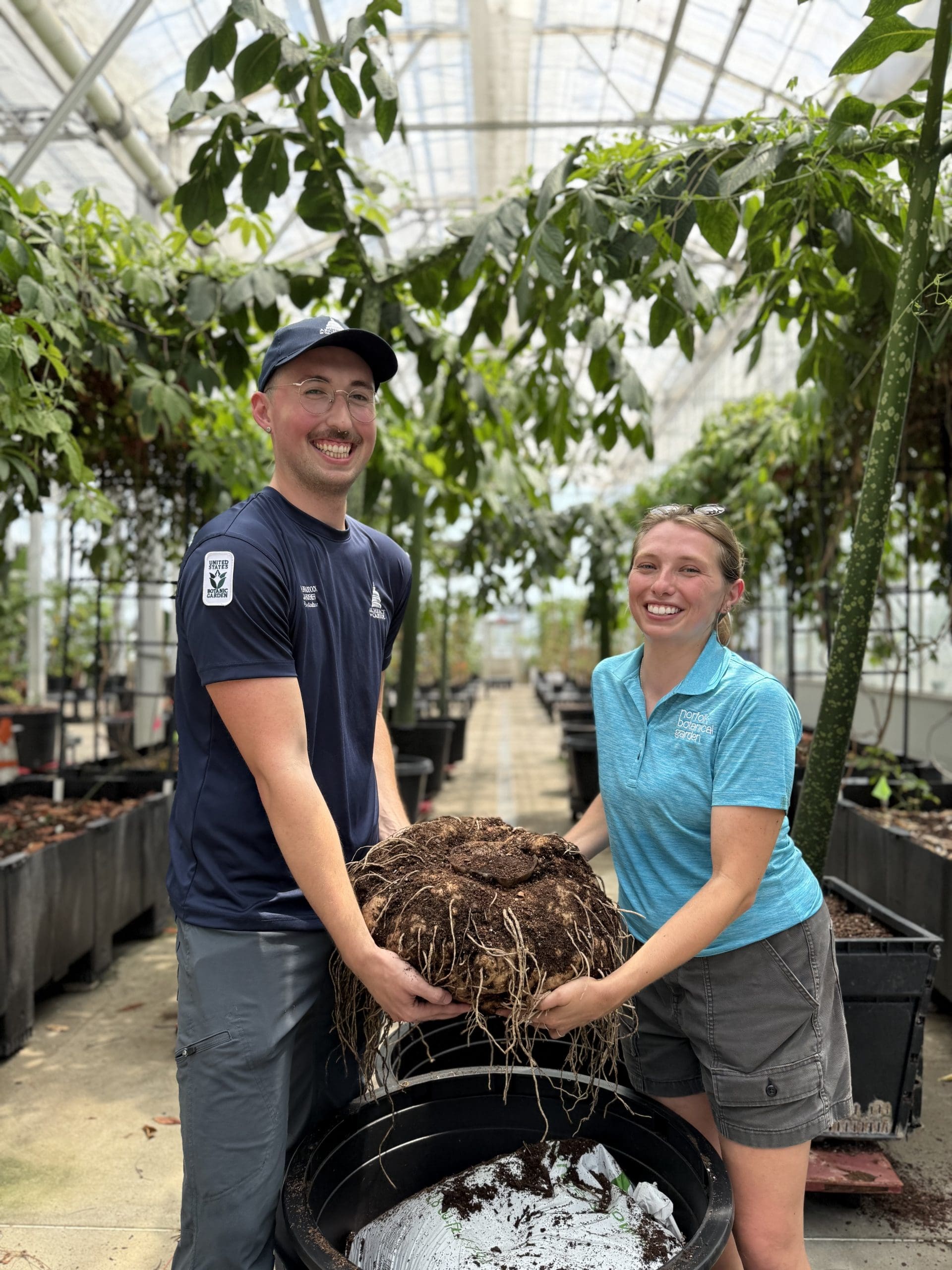
As a symbol of strengthening partnerships with other institutions, the Garden received an incredible gesture of support
from the United States Botanical Garden: a donation of a blooming-sized Amorphophallus titanum, also known as
“Corpse Flower.”
This gift is particularly special because there are fewer than 1,000 corpse flowers left in the wild. It is classified as endangered by the International Union for Conservation of Nature (IUCN), primarily because of habitat loss from the conversion of natural forests into palm oil plantations. Palm oil is a common ingredient in many processed food and household items such as instant noodles, cookies, cosmetics, soaps and detergents, peanut butter and breakfast cereals.
This gift is more than a rare botanical treasure — it is a valuable teaching tool about the urgent lesson of conservation, challenging us to consider how our everyday lifestyle and consumer choices are intricately connected to the survival of the Earth’s most extraordinary plants. I is also a reminder that we are all deeply interconnected, our lives and choices rippling even to the far reaches of the Sumatran rainforests. So, beyond the rarity, what makes the Amorphallus titanum such a headliner when it blooms?
One of the main draws is its sheer size. It is the largest unbranched inflorescence (a flower arrangement along a single, unbranched axis) in the plant kingdom. In the wild, they can grow up to 12 feet tall, but in cultivation they typically grow about 8 feet tall. The diameter of the flower can be close to 3 feet. Additionally, bloom time can be a bit unpredictable, adding an element of elusiveness to witnessing this event. It takes approximately seven to 10 years for the corm to gather enough energy to bloom. The corm can weight more than 200 pounds once it reaches blooming size!
In addition to being one of the largest flowering plants in the world, it is also one of the smelliest. The rotten flesh smell combined with heat-producing thermogenesis to disperse the odor, is an ingenious evolutionary strategy to attract its primary pollinators —carrion beetles and flies. Once these insects are lured in, their exploring inadvertently transfers pollen, leading to successful pollination. As the Garden prepares to welcome this extraordinary plant, we invite you to witness not only its otherworldly beauty, but also the powerful story it tells—one of wonder, fragility, and our shared responsibility to protect it. The arrival of this rare gift at the Garden is more than just an event, it’s a call to curiosity, connection and conservation.
Pictured to the right is the Corpse Flower (Amorphophallus titanum) in bloom at the United States Botanic Garden