If you believe that a family member was part of the original 220 African American workers through the Works Progress Administration (WPA), please email us at marketing@nbgs.org or call us at 757-441-5830 ext. 332.
norfolkbg

WPA Memorial Project
Preserve History
Your contribution will help us to maintain the WPA Memorial Garden and continue to tell the story of the WPA workers and their legacy for future generations.
Honoring Their Stories
The WPA Memorial Project was created to honor the individuals whose labor made Norfolk Botanical Garden possible and to preserve their legacy for future generations.
Through ongoing research, storytelling, the annual WPA Heritage Celebration, and the WPA Scholarship, Norfolk Botanical Garden continues to recognize their contributions and ensure their names and experiences are remembered.
Today, we honor not only what these workers built, but also the resilience, skill, and perseverance they demonstrated in creating a lasting legacy for our community.
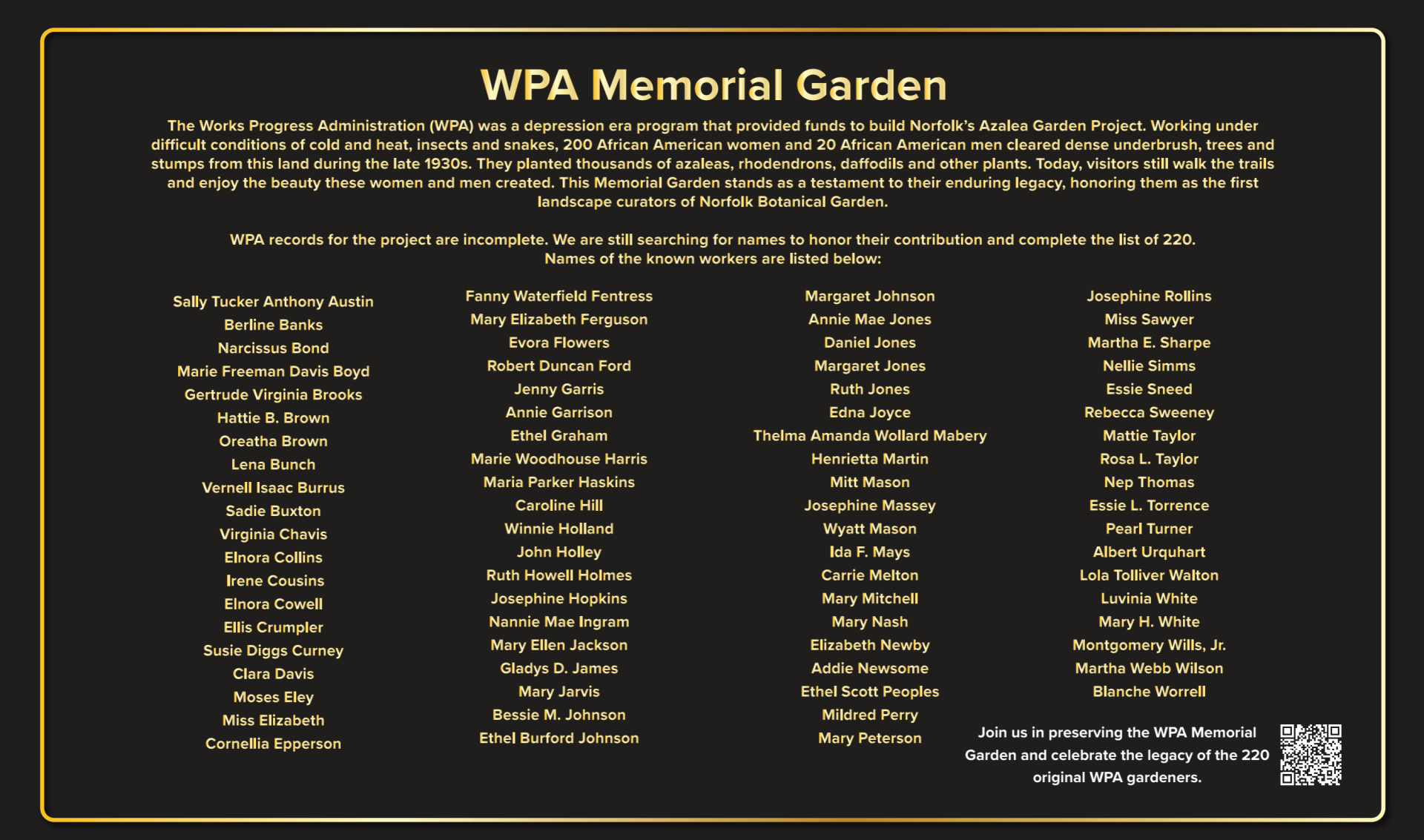
Known WPA Workers
If you believe that a family member was part of the original 220 African American workers through the Works Progress Administration (WPA),please email us at marketing@nbgs.org or call us at 757-441-5830 ext. 332.
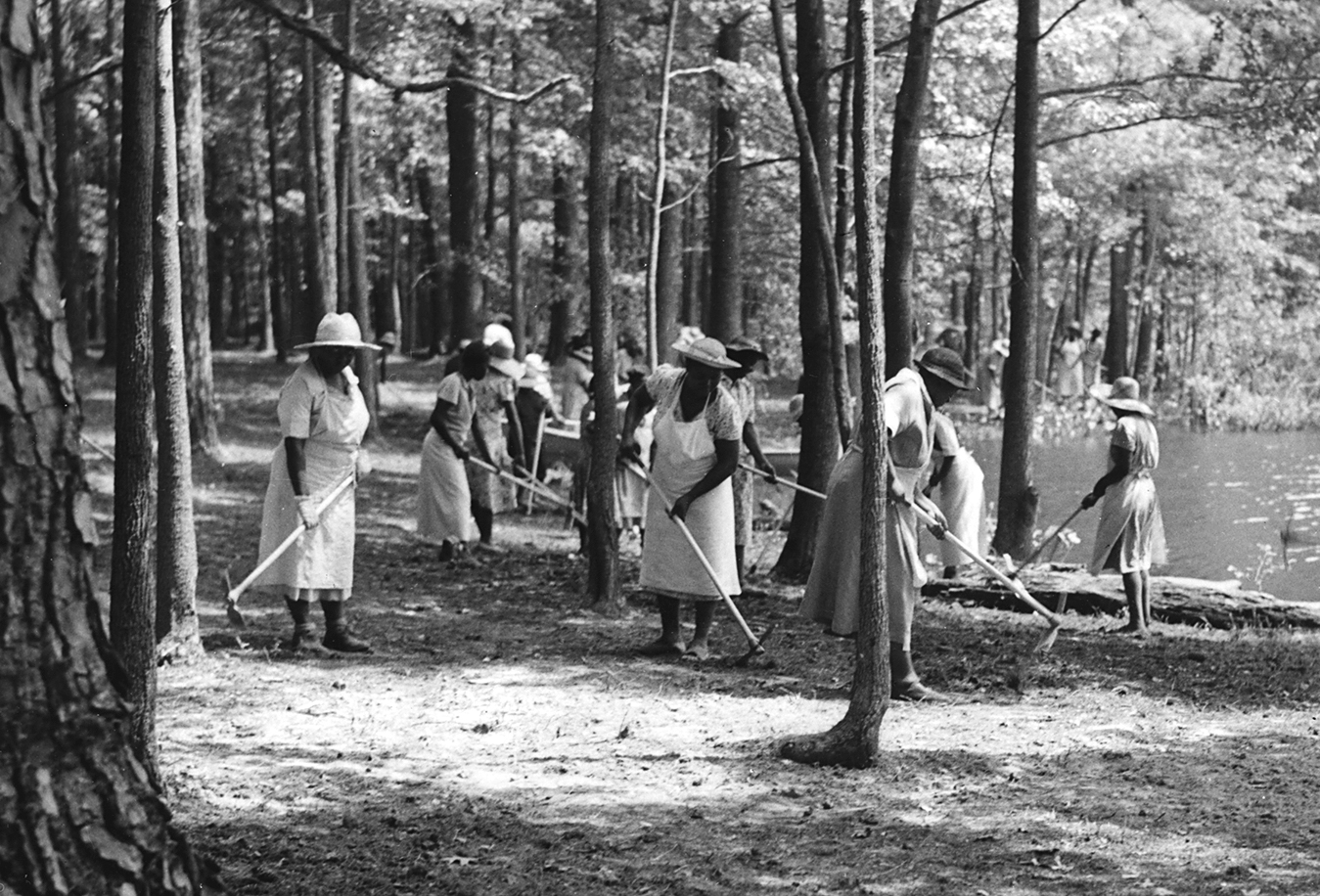
For four years, these workers cleared dense vegetation, removed trees and stumps, and shaped the land using only pickaxes, hoes, shovels, and wheelbarrows. They carried the equivalent of 150 truckloads of dirt by hand to build a levee for the surrounding lake.
Their work required extraordinary endurance. From dawn until dusk, they labored through Norfolk’s harsh summers, cold winters, rain, and snow, while facing challenges including snakes, mosquitoes, ticks, and poison ivy. Despite the difficult conditions and limited resources, they continued the demanding work of transforming the land.
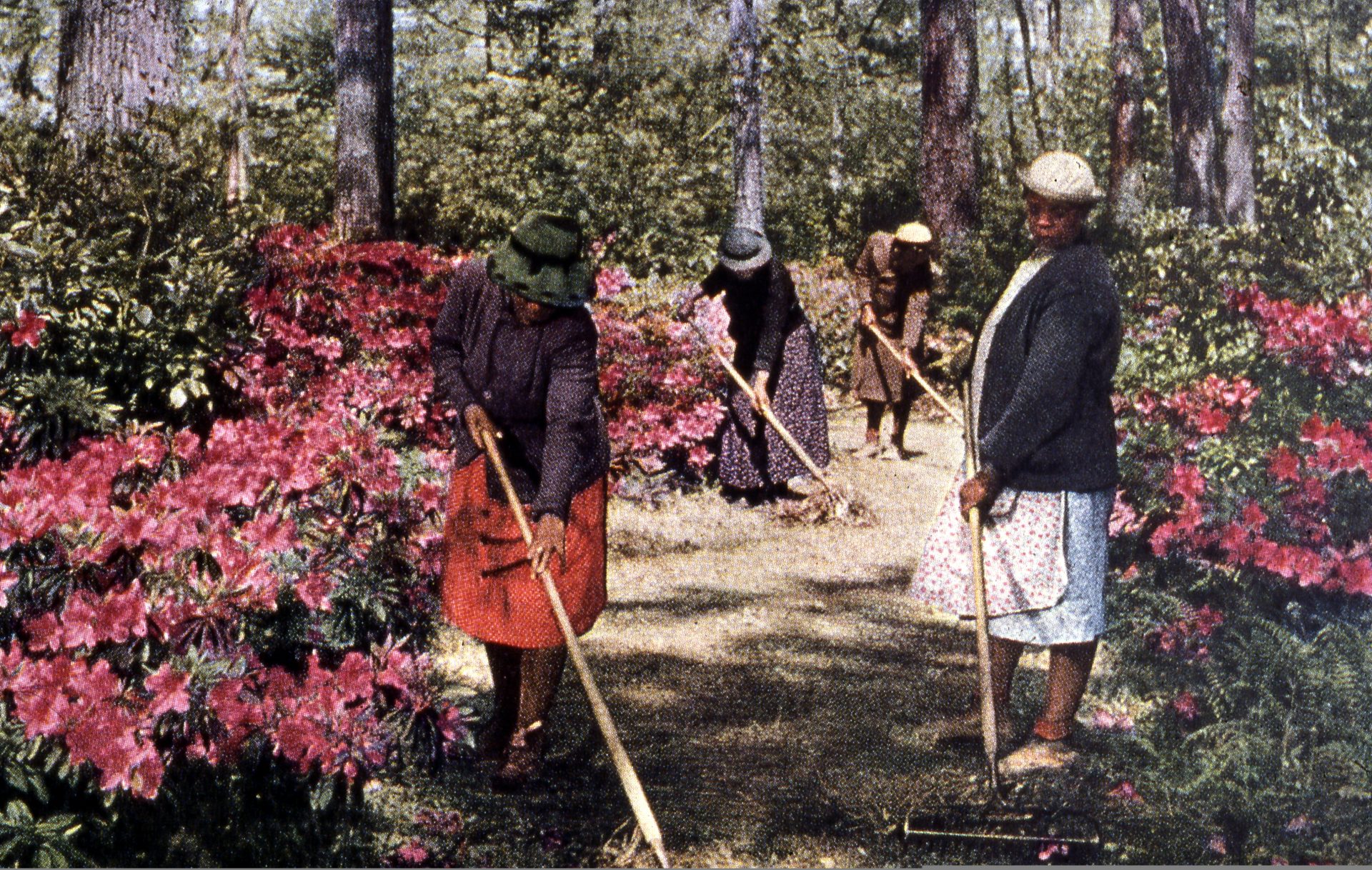
Through their dedication, the workers laid the foundation for Norfolk Botanical Garden. By March 1939, thousands of azaleas, rhododendrons, camellias, shrubs, and daffodils had been planted, transforming the once-overgrown landscape into a garden that reflected the beauty and design of its era.
Their contributions extended far beyond the physical landscape. The skill, perseverance, and determination of these workers created a place that has inspired generations of visitors and continues to serve the community today.
Breaking Ground
“Breaking Ground” is the design and creation of an original larger-than-life-size bronze sculpture honoring the 220 African-American women and men employed through the WPA Project to labor in the tree-filled swampland from 1938-1942. The artist used photos of actual WPA workers from the era and an African-American female model. The above photo is of Mary Ferguson who was last known living WPA worker in front of the memorial sculpture.
The Garden, poem by Gracie Anthony
At the base of the statue features an excerpt of the poem The Garden, written by Gracie Anthony daughter of Josephine Hopkins, one of the original WPA workers.
Garden Club – WPA
This life-size painting Garden Club – WPA was created by award-winning Norfolk artist Maizelle and has been showcased at the Chrysler Museum of Art. It pays tribute to the 220 African American women and men, who, as part of a depression era Works Progress Administration project, transformed swampland into the beautiful Garden we know today.
Suggested Reading
The Norfolk Botanical Garden: A Natural Treasure
by Amy Waters Yarsinske
First Gardeners Norfolk Botanical Garden
by Martha M Williams
WPA Original Gardeners: Norfolk Botanical Garden
by Martha M Williams
How Students Rediscovered the Original Gardeners
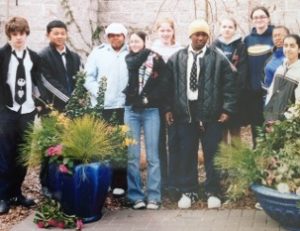
According to her own account, Dr. Martha McClenny Williams, author of WPA Original Gardeners, was asked to serve on the Norfolk Botanical Garden Board beginning in 2003 for 2 three year terms. A group of middle school students came to the garden because they had just formed a new club “Future Problem Solvers of America”. They had to find a local organization that had a problem they could solve. It was a group of about 15 students.They wanted to help because Hurricane Isabel had just hit hard – about 300 trees had fallen down and they wanted to help with that, but they were too young to do that type of work.
A second alternative was helping with increasing the diversity at the garden. As they began to search the history they found that 220 African American men and women were the original gardeners and that they were asked to clear the land and build an azalea garden. The students were amazed when they found out and they wanted to begin to tell this story because no one had heard anything about it! And so the students advertised to find out if any gardeners were still living and they did find one original gardener at that time, in 2004. She was 80 years old and had not been back to the garden since she left in 1942. [Source: https://www.youtube.com/watch?v=8MAmPFanyMo]